What Gauge Needle Does Red Cross Use . This will vary from country to country. You may be able to push blood* through this size if you can’t use an 18 gauge, but always check your employer’s protocol. Top 10 Best Embroidery Hoops Reviews With Scores from porchandprairie.com Watch this video for tips on how to overcome your fear of needles when donating blood or platelets. 5 mm [us 8] yarn needle. Sometimes, local blood banks or even the red cross itself will hire phlebotomists as employees, instead of just volunteers.
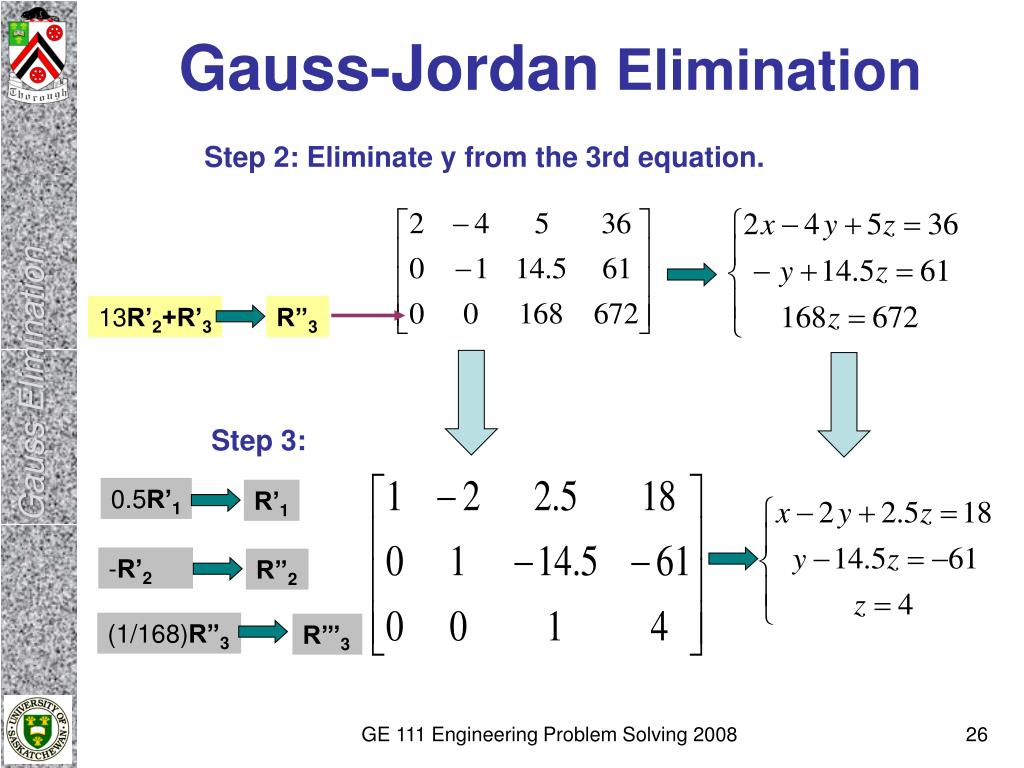
Gauss Jordan Elimination With Two Equations. Look at the rst entry in the rst row. Write the augmented matrix of the system.
PPT GAUSS ELIMINATION AND GAUSSJORDAN ELIMINATION from www.slideserve.com
Select the correct choice below and, if necessary, fill in the answer box (es) to complete your choice. Look at the rst entry in the rst row. Now, subtract r 2 from r 3 to get the new elements of r 3, i.e.
First, The N By N Identity Matrix Is Augmented To The Right Of A, Forming A N By 2N Block Matrix [A | I].
Use row operations to transform the augmented matrix in the form described below,. Write the system of equations as an augmented matrix. Set b 0 and s 0 equal to a, and set k = 0.
We Obtain The Reduced Row Echelon Form From The Augmented Matrix Of The Equation System By Performing Elemental Operations In Rows (Or Columns).
Swap the positions of two of the rows; For our next move, we'll add \ (2/3\) times the third equation to the second equation. X 1 − 3 x 2 = 21.
Y + 2Z = 3.
Select the correct choice below and, if necessary, fill in the answer box (es) to complete your choice. Check the answer by substituting the numerical values of x, y and z into the original equations: For the purposes of this example, let's continue with elimination.
It Is Similar And Simpler Than Gauss Elimination Method As We Have To Perform 2 Different Process In Gauss Elimination Method I.e.
This is called pivoting the matrix about this element. Solve the following system of equations. Subtract r 2 from r 1 to get the new elements of r 1, i.e.
There Are Three Elementary Row Operations Used To Achieve Reduced Row Echelon Form:
If a is a n by n square matrix, then one can use row reduction to compute its inverse matrix, if it exists. These operations will not change the roots to the set of equations, since such operations are equivalent to multiplying all terms of one equation by a constant or to taking the sum or difference of two equations. Solving a system of linear equations using gaussian elimination solve the following system of linear equations using gaussian elimination.


Comments
Post a Comment